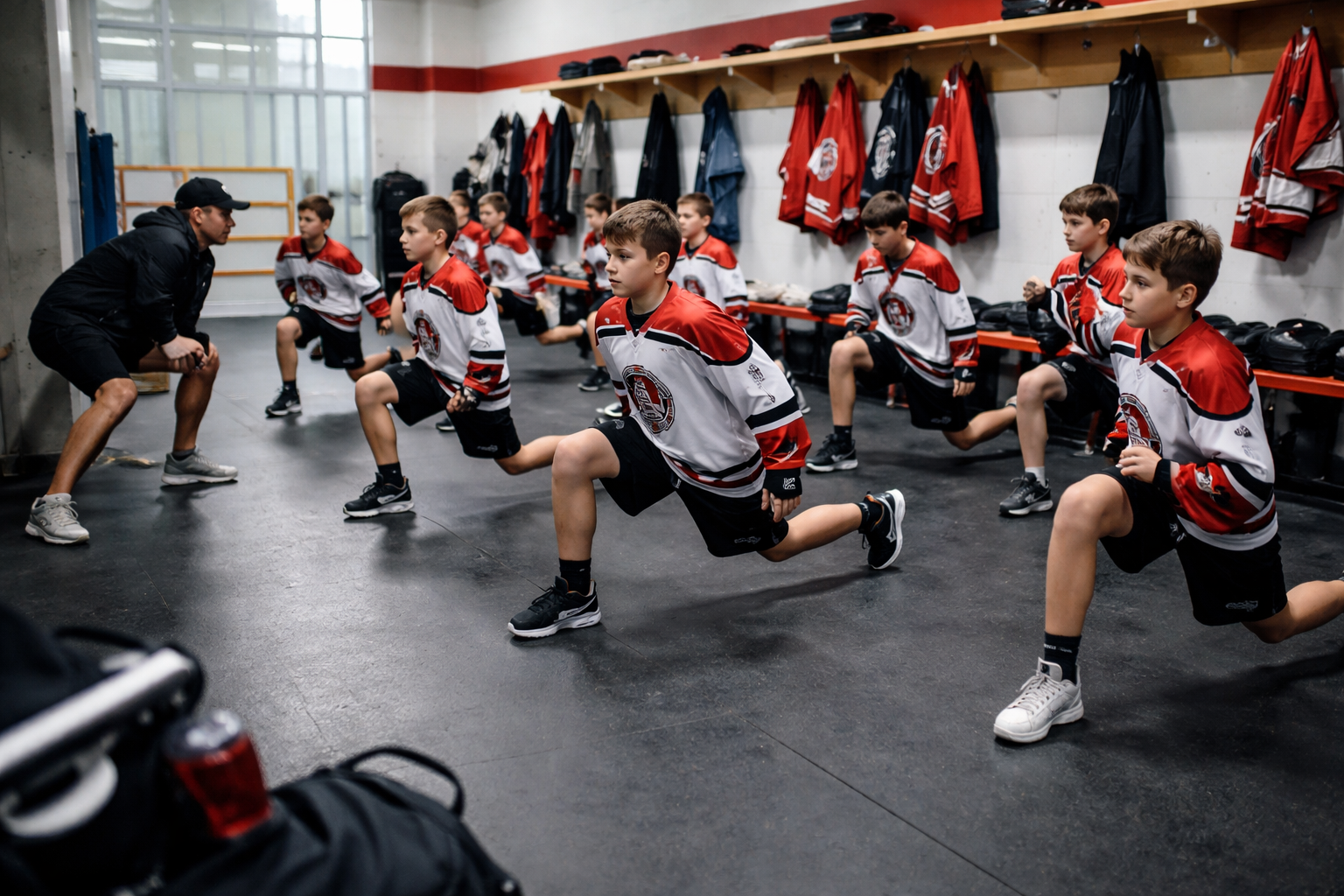
Warm up for performance



The importance of “locking in”
with a proper warm up
Before the skates go on and the first puck drops, the most important part of performance has already started: the warm-up.
A proper pre-dress routine doesn’t just raise your heart rate—it activates the muscles and the mind for performace.
It also helps players feel
sharper
more confident
ready to compete from the first shift.
Whether it’s practice or game day, a few minutes of intentional warm-up can make a big difference!
1) It “turns on” the right muscles for skating power and control
Hockey isn’t just legs—it’s glutes, hips, core, and upper back working together. A good activation warm-up wakes up the “engines” that create stride power and stability, so players:
push harder without feeling heavy-legged
stop and start faster (better acceleration)
stay more balanced in battles and turns
feel smoother on edges and transitions
👉 When those key muscles are asleep, the body tends to rely on smaller muscles (like quads/hip flexors) and movement can feel choppy, slower, and less controlled.
2) It reduces injury risk by preparing joints and tissues for hockey speeds
Hockey has explosive changes of direction, contact, awkward positions, and hard stops. Warming up helps by:
increasing blood flow and tissue temperature (muscles move better when warm)
priming hips, groin, ankles, and knees for lateral movement
improving joint control so you’re less “loose” or unpredictable in cuts and collisions
👉 A warm-up doesn’t make injuries impossible—but it can lower risk by getting the body ready for the demands you’re about to place on it.
3) It improves coordination and reaction time (your “on-ice timing”)
Warm-ups aren’t just about sweating—they’re about your nervous system. When you activate and move with intention, you sharpen:
foot speed and body awareness
timing between brain → muscle → movement
reaction speed for loose pucks, quick passes, and sudden direction changes
👉 That’s why players often say they feel “a step behind” if they skip a warm-up—your system hasn’t fully switched into hockey mode yet.
4) It helps players get mentally locked in and confident
A consistent warm-up routine is like a pre-game switch. It gives players structure and control—especially helpful for nerves. It can:
reduce pre-game anxiety by focusing on a routine
build confidence (“I feel ready”)
improve concentration by narrowing attention to a few simple cues
👉 When warm-ups are rushed or skipped, players often start games feeling scattered, hesitant, or overwhelmed—then need 5–10 minutes on the ice to finally settle.
5) It leads to a better first shift and higher-quality practice reps
In hockey, the start matters. A proper warm-up helps players:
hit game pace sooner
make cleaner first passes and decisions
skate with better posture and control right away
avoid the “first 10 minutes are rough” problem in practice
👉 Over a season, that adds up: more high-quality reps, better development, and more consistent performance.
For the coaches
Pro Tips: How to get full team buy-in on the warm-up
1) Make it player-led (Captain + Assistants run small groups)
🏒 Assign your captain and assistants to each lead 3–4 players. : Give them the simple job: keep the group moving and attentive.
This instantly creates ownership, reduces messing around, and makes the warm-up feel like part of the team culture—not “something the coach is nagging about.”
2) Keep a coach present—but coach the standards, not the whole warm-up
🏒 Have a coach nearby to monitor effort and focus: Correct the big things (posture, tempo, control), and keep the vibe focused.
You’re not there to micromanage every rep—you’re there to make sure the warm-up looks the same every time: organized, quick, and game-ready.
3) Make it automatic: short, simple, same routine every time
🏒The best warm-up is the one that actually happens: Keep it 6–8 minutes, repeat the same sequence, and rotate 1–2 small variations weekly to keep it fresh.
When players know what’s coming, they stop arguing, stop delaying, and start moving—because it’s just “what we do.”